
This is a version of the Microsoft Access 2000 Northwind sample database, re-engineered for SQLite3. The Northwind sample database was provided with Microsoft Access as a tutorial schema for managing small business customers, orders, inventory, purchasing, suppliers, shipping, and employees. Anyone can view the repository contents and download historical versions of individual files or ZIP archives of historical check-ins. You can also clone the entire repository. See the How To Compile SQLite page for additional information on how to use the raw SQLite source code.
- Similar Software for Mac. Install Pd on Mac OSX; Install WireOver on Mac OSX; Install CLion on Mac OSX; Install Zipeg on Mac OSX; Install Zoom.us on Mac OSX; Install YY on Mac OSX; Install Zoho Docs on Mac OSX; Install ZeroTier One on Mac OSX; Install Zotero on Mac OSX; Install Zed on Mac OSX.
- Download Csv Editor For Os - real advice. Sequel Pro and 1 more program. SQLiteStudio 3.1 Free. SQLiteStudio is a SQLite database manager software. Music Tag Editor is a Mac.can export CSV files, download. Quick 'n Easy Web Builder.
- Download SQLiteStudio Freeware, File size: 17196646.4, OS: Windows All, Price:0.00 Download SQLiteStudio 3.1.1 software Home Windows Mac Scripts Drivers News.
SQLite Studio is a nice application that can be used on Window, Mac and Linux, so everyone can use it. You'll need to download it from the developer website at sqlitestudio.pl. Please see the wiki and forums at that site for any install assistance that you need.
When SQLite Studio starts, it needs a database to work with. You will want to protect the original ATDNA Helper database, so step carefully through making a working copy. You'll want to do this each time your database changes.
You will need to navigate very deeply into the Chrome structure to find the database.
The ATDNA Helper documentation has a good description of how to find it on Windows 7. My username on my PC is Beth so my path to the database is this:
C:UsersBethAppDataLocalGoogleChromeUser DataDefaultdatabaseschrome-extension_hjflmfphflaeehhpdiggobllgffelfee_01
The AppData folder is hidden on Windows. If you can't find it, set your folder and file options to show hidden objects. Here's how my options look.
On a Mac, the database is also in a hidden folder. See detailed information at the end of this page for how to find it. The path to the database on our Mac is this:
Users/Beth/library/Application Support/Google/Chrome/Default/databases/chrome-extension_hjflmfphflaeehhpdiggobllgffelf ee_0/1
The file name will just be a number. It will be the number 1 unless you have uninstalled and reinstalled the Helper. The number bumps up by 1 each time you do so. My number is 1, so I choose the file 1 and copy it to My Documents. Place the copy wherever it makes sense to you.
SQLite Studio prefers files that end in .db3, but it's your decision whether to rename the file. The most important thing is that you recognize the name and that you know it is not the real database. Leave the file named similar to 1 or rename it to suit. I renamed mine to 1master.db3.
Start the SQLite Studio application and connect to your database copy. Click on Database on the menu and then click on Add a database.
Select the default database type of SQLite 3 and click on the file folder to browse for your database.
Navigate to your database copy. If you did not rename it to end in .db3, change the file type selection at the bottom right so that you can find the file.
You can choose to name the database differently in the list, or just accept the name given by the application. You can also choose to make the database a permanent addition to the list of available databases.
Once the database is in the list, you can connect to it, work with it and disconnect from it. The connect and disconnect can be done from icons or from the database menu. First connect to the database.
Here is the menu.
Here's the icon.
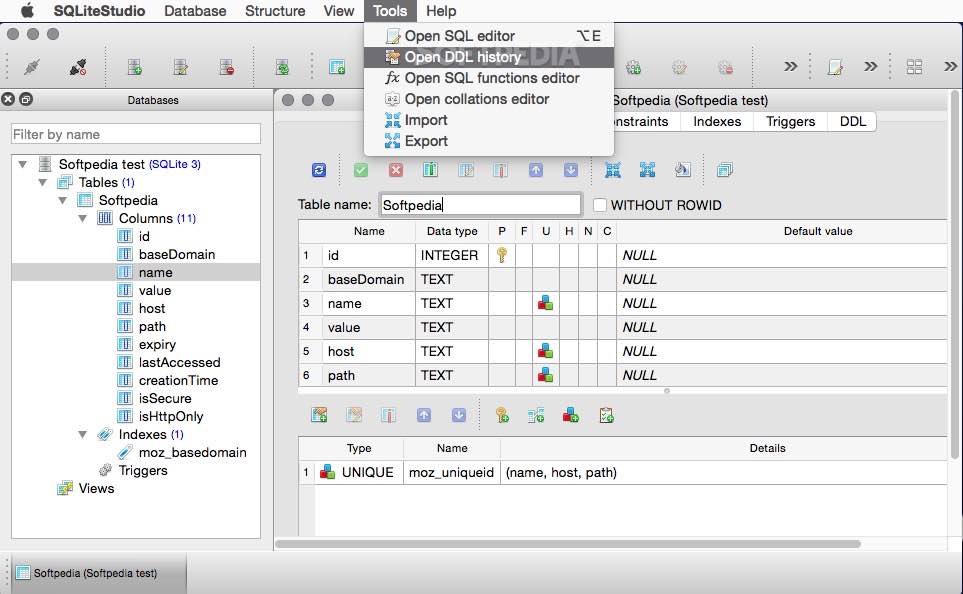
When the database opens, the name (1master) is at the top of the list on the left side. To look at a table, such as tests, double-click on the table name. Alternately click the table name and choose Structure and Edit the Table.
When the window opens, choose the Data tab to see the data. The title bar will show what is active and all open windows (which can stack up) will be shown on the bottom of the screen. Use the inner set of window controls to control or close the edit window.
This site shares SQL queries that you can use to work with your database. You can use SQLite Studio to look at your data, though the number of matches and ancestors can be a huge amount of data. Queries are a far better option.
When you're done and ready to close, choose the menu or icon to disconnect from the database.
SQL queries for your database are on other pages of this site.
If you are using a Mac and can't find the database, please try the following. We're just learning about MacOS, so this may be stated incorrectly. Comments are welcome.
- Open the Finder.
- Click on the 'Go' menu in the top menu bar.
- Hold down the 'Option' key on the keyboard.
- 'Library' should appear in the menu between 'Home' and 'Computer'. There you will find the 'Application Support' folder. The reason you can't normally see this folder is that the Library folder is invisible.
- The path to the file is:
Users/USERNAME/library/Application Support/Google/Chrome/Default/databases/chrome-extension_hjflmfphflaeehhpdiggobllgffelf ee_0/FILENAME - USERNAME is your user name. FILENAME is just a number which starts at 1. Each time you remove and add the extension, the number goes up by 1.
- Look for any simple file name in that folder.
- From the Finder, you can copy the file to another folder.
Originally published November 2016. Revised December, 2017.
Latest review/revision: July 5, 2019
(Please consider sponsoring us on Patreon 😄)
Windows
Our latest release (3.12.0) for Windows:
Note - If for any reason the standard Windows release does not work(e.g. gives an error), try a nightly build (below).
Nightly builds often fix bugs reported after the last release. 😄
macOS
Our latest release (3.12.0) for macOS:
Homebrew
If you prefer using Homebrew for macOS, our latest release can be installed via Homebrew Cask:
Nightly builds
Download nightly builds for Windows and macOS here:
Linux
DB Browser for SQLite works well on Linux.
Arch Linux
Arch Linux provides an up to date version
Install with the following command:
Fedora
Install for Fedora (i386 and x86_64) by issuing the following command:
openSUSE
Debian
Note that Debian focuses more on stability rather than newest features. Therefore packages will typically contain some older version, compared to the latest release.
Update the cache using:
Install the package using:
Ubuntu and Derivatives
Stable release
For Ubuntu and derivaties, @deepsidhu1313provides a PPA with the latest release here:

To add this ppa just type in these commands in terminal:
Then update the cache using:
Install the package using:
Ubuntu 14.04.X, 15.04.X, 15.10.X and 16.04.X are supported for now (untilLaunchpad decides to discontinue building for any series).
Ubuntu Precise (12.04) and Utopic (14.10) are not supported:
- Precise does not have a new enough Qt package in its repository by default,which is a dependency
- Launchpad does not support Utopic any more, which has reached its End ofLife
Nightly builds
Nightly builds are available here:
To add this ppa, type these commands into the terminal:
Then update the cache using:
Install the package using:
Other Linux
Sqlitestudio Download
On others, compile DB4S using the instructionsin BUILDING.md.
FreeBSD
DB Browser for SQLite works well on FreeBSD, and there is a port for it (thanksto lbartoletti 😄). DB4S can be installedusing either this command:
or this command:
Snap packages
Sqlitestudio 3.2.1
Snap Nightlies
Sqlitestudio 3.1.1 Download
Snap Stable